Welcome. Enjoy. Respect.
Let nature remain as we found it.
Welcome to our home
Here in Slovenia, we’ve got a rather lovely custom. When you pop round to someone’s place for a visit, you slip off your shoes. And what does your gracious host do? They offer you a pair of comfy slippers, so you’re not padding about barefoot! Well, visiting our marvellous destination is a bit like that. Welcome to our home! We’re absolutely thrilled that you’ve decided to explore our captivating corners and uncover their breathtaking, still largely untouched natural wonders. To keep them that way, we kindly ask you to treat everything you encounter on your journey – both nature and people – with understanding and respect. Now, don’t you fret, this isn’t some dreary, tedious lecture about dos and don’ts. We simply want to give you a peek behind the curtain of what makes up our home, and where you’ll discover all our little “slippers”!
Our dazzling destination, Kranjska Gora, nestles right at the crossroads of Slovenia, Italy, and Austria. It’s truly the beating heart of the Julian Alps! Imagine vibrant meadows hugged by towering peaks rising high towards the sky, their majestic reflections shimmering in the crystal-clear lakes down in the valley. On one side, the mighty Karavanke mountain range embraces us, while on the other, the magnificent Julian Alps stand guard. Winding its way through the valley is the Sava Dolinka River, which springs to life above the Tamar Valley head, then playfully dips underground, only to gurgle back to the surface in the enchanting Zelenci Nature Reserve.
All these wonders have one thing in common. They are part of a protected area! You see, a good chunk of it falls within the Triglav National Park, where for over a century dedicated folks have passionately championed the protection of nature and its inhabitants. This park is the very soul and heart of the Julian Alps Biosphere Reserve – a pioneering nature reserve in Slovenia. Some of them are also protected as part of the Natura 2000 network whose mission, for generations, has been to preserve nature in its pristine form and safeguard its precious flora and fauna. Our ancestors consciously began developing tourism over a hundred years ago, and to keep nature pristine, we had to find a delicate balance between the two. We want our hospitality to be felt at every step, so visitors from near and far can truly sense our heartbeat and find peace for their restless (urban) souls in our forests. Slovenia’s woods are its lungs, and it has been scientifically proven that walkers, hikers, and mountaineers actively help their bodies find balance when doing their activities here. We are a ClimActive (climatically active) destination – something our forebears already understood, and we hope future generations will, too. Spending time in our neck of the woods and wandering through our forests has been scientifically shown to benefit health and boost wellbeing. We want to preserve nature just as it is, because only unspoilt nature can help us maintain our health. Only pure rivers, lakes, and waterfalls can help us take a load off by carrying it away down the white water rapids.
The mountains surrounding us have always beckoned locals, especially in the mountaineering village of Dovje-Mojstrana, where they discovered both the dangers and the beauty of steep cliffs and sheer rock faces, and then went on to fearlessly conquer even the 8,000-metre giants of the Himalayas. Mountain culture is woven into the very identity and heritage of the people living in the villages beneath Triglav.
As Jakob Aljaž, the priest from Dovje, wrote: “Oh, Triglav, my home, how splendid you are, how you lure me from lowlands in summer heat to steep peaks, where my heart finds rest in solitude.” And even 130 years later, nothing has changed. Enthralled by our mountains, climbers long to escape into their embrace, to unwind and let their hearts rest from the frantic pace of everyday life. Yet before every ascent, it’s vital to honestly ask yourself how much you can manage and choose a peak that matches your abilities and fitness – one you can conquer without undue strain or putting yourself and the devoted mountain rescue volunteers at risk.
Just as we must respect the mountains, we must respect the animal and plant life that lives there. Let the delicate edelweiss that grow on steep slopes remain untouched – admire their beauty and resilience against the harsh mountain conditions, but don’t leave behind the wrappers from the energy bars that gave you strength on your ascent. If you bring your four-legged friend into nature, keep them on a lead to ensure their safety, and always clean up after them. Droppings aren’t pleasant to look at and can even threaten the lives of grazing animals if consumed.
Summarised from the following sources: TNP website | Julian Alps Biosphere Area website | Natura 2000 website | Julian Alps Catalogue
Natural attractions
Vitranc
Vitranc is a mountain on the edge of the Julian Alps and the Triglav National Park, with two trails leading to it.
Dovška baba
This beautiful 1891 m high mountain in the Karavanke Mountains is hidden above the village of Dovje.
Martuljek mountain chain
He took a handful of all nice with his hand, weaving them into a wreath over the valley deep.
Enjoy
Time runs differently in Kranjska Gora. Here, the seasons don’t just change, they flow seamlessly into one another like watercolours blending softly over peaks, valleys, rivers, and trails. There’s just the right amount of everything, never too much, never too little. Welcome to a place where people don’t merely preserve tradition, but truly live it. Where nature isn’t just a backdrop, but a conversation partner. A place where the genuine meets the modern – without noise, without rush.
A dense, lovingly maintained network of marked mountain trails, cared for by dedicated volunteers for decades, is more than just a map – it’s the very heart of Slovenian mountaineering. Along these paths stand mountain huts and shelters, opening up views you won’t soon forget. If you’re not experienced enough, it’s best to explore the mountains accompanied by a licensed guide. That doesn’t mean less freedom – quite the opposite. It means more safety and a richer, more authentic experience. For those who prefer pedalling to stepping, Kranjska Gora offers a wide range of cycling trails – from gentle rides along the former railway line that once linked Slovenia with Italy, to daring climbs up the hairpin bends of Vršič, Slovenia’s highest mountain pass, or adrenaline-pumping descents on marked singletracks.
Culture and tradition are woven into the daily lives of the locals. The people draw strength from nature, respect the seasons, and create an environment where heritage is not just history, but a way of life. This spirit shines through in the products of the collective brand Kranjska Gora Vrhunsko.
And speaking of the skilled hands of locals – they prepare dishes that smell of meadows, gardens, and the times of our grandmothers, when the kitchen was filled with the divine aroma of lovingly crafted homemade meals. In mountain huts and homesteads, tables bend under the weight of simple yet lovingly prepared dishes. Meanwhile, internationally renowned restaurants blend local flavours with global culinary imagination. The stars of Michelin, Gault & Millau, and Bib Gourmand — in Kranjska Gora, a world of Julian Alps flavours awaits you.
If you’re after moments that make your heart race, let your path lead you above Mojstrana or to Gozd Martuljek, where exciting via ferratas and rock faces await. On Europe’s steepest zipline, soaring above the giant hill in Planica, you can feel what it’s like to fly like a bird – or a ski jumper.
However, if you feel drawn to the ground, to silence, to yourself, then Kranjska Gora is your sanctuary of peace. By the lakes reflecting the mountains, in forests where silence speaks, or in the warm embrace of alpine wellness retreats where your breath finds its rhythm – here, slow living doesn’t announce itself, it simply happens. With a view. With a deep breath. With the feeling that you’ve come home – at least for a few days.
In Kranjska Gora, you’re not just promised a break. You’re guaranteed an unforgettable experience that inspires respect for the surroundings. And a greeting that says it all: Welcome to our home.
Summarised from the following sources: Julian Alps Catalogue
Activities
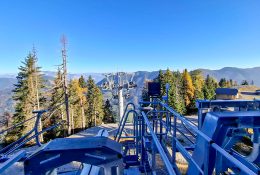
Panoramic Ride on the Vitranc 2 Chairlift
The Vitranc 2 chairlift takes you to the summit of Vitranc, where you’ll be treated to a magnificent view of the Julian Alps, the Karawanks, and neighboring Austria and Italy.
Ledena Planica Ice Rink
The Ledena Planica Ice Rink, covering 900 m², is considered one of the largest ice rinks in this region.
A fairytale winter village by Lake Jasna
Where the silence of snow-covered mountains meets the magic of festive lights.
Rute Forest Educational Trail
The forest educational trail reveals characteristic tree species, shrubs, and protected mountain vegetation.
Cycling Trail to the Krma valley
A cycling route that winds through the longest valley under Triglav.
Cycling Trail to Jurež pasture, Vošca, Železnica
One of the most panoramic tours around Kranjska Gora, with a beautiful view of the Julian Alps accompanying us at all times on this route.
Cycling trail to the Dovška Rožca Alpine Pasture
A scenic cycling climb through forests to a scenic mountain with breath-taking views of the Karavanke Mountains, the Julian Mountains and Mežakla.
Dovje - Jesenice Cycling Trail
The wide valley between Dovje and Jesenice lies between the sunny Karavanke Mountains and the shady Mežakla Mountains, connected by a scenic forest road.
Cycling trail to Srednji Vrh
A steep cycling climb with stunning views of the Martuljka Group and the murmuring waterfalls of the Jerman Stream.
Respect
Visiting Kranjska Gora and its untouched mountain surroundings is a unique opportunity to experience nature in its purest form – from Alpine valleys to panoramic peaks. But this very beauty warrants respect, responsibility, and readiness. The mountain is not crazy – it’s up to the person who climbs it to act wisely.
Plan your tour carefully, tailored to your experience and physical fitness. It’s vital to choose trails that match your abilities, and to have the right equipment and knowledge for a safe ascent. Take into account the difficulty of the routes and don’t overestimate your skills – it’s better to start on a lower-rated trail and gradually increase the challenge. Before setting out, check the weather forecast, trail conditions, and whether mountain huts are open.
Not all mountain paths are the same. Some require only good physical fitness and proper footwear; others demand additional safety gear. For challenging or very demanding routes, helmets, climbing harnesses, and self-belaying kits are mandatory. Remember, despite their relatively moderate altitude by Alpine standards, our mountains are extremely demanding and require respect. Difficult mountain trails traverse limestone terrain that is often loose and, combined with fog and bad weather, slippery and hard to navigate. Snow can linger well into summer, and without proper winter equipment, it can turn into a deadly slide down the valley. Using maps, apps, and having orientation skills are also key to your safety. Before you set off, make sure to inform your family, friends, or the staff where you’re staying about your route and expected return time. Signing the registration books at the summits can be a lifesaver in case of an emergency.
If you’re not experienced enough, it’s best to explore the mountains accompanied by a licensed guide. That doesn’t mean less freedom – quite the opposite. It means more safety and a richer, more authentic experience.
Remember that some mountain areas are closed seasonally, or dangerous due to weather events or natural obstacles. You can always get up-to-date information from mountain huts or local guides.
While walking, follow the trail markers and do not venture off the designated paths. Be aware that you are in a delicate natural environment where peace is a privilege shared by animals, locals, and hikers alike. Although the finest hotel is the open sky with a thousand stars, camping or overnight stays outside mountain huts and designated areas are not permitted. There are plenty of beds available in mountain huts and valley campsites.
When travelling between tourist points in the valley or to trailheads, please use public transport. If you’re driving, check the locations of official, regulated parking areas and always respect parking rules.
Be a responsible visitor: carefully protect nature both in the valley and the mountains. Do not litter; separate your waste; keep water sources clean; and respect the flora and fauna. Avoid disturbing wildlife by cycling only in permitted areas, and be aware that cycling is expressly forbidden in parts of the park.
In Kranjska Gora, nature is not just a backdrop — it’s a treasure. Visit it with respect and responsibly — for yourself, for others, and for future generations. Only then can you fully experience all that this wonderful mountain world has to offer — safely, sincerely, and memorably.
Summarised from the following sources: TNP website | Alpine Association of Slovenia (PZS) website | Julian Alps Catalogue | Slovenian Tourist Board (STO) website | Mountain Rescue Service (GRS) website
Where to park?
Check the list of parking areas in the Kranjska Gora destination.
Vrata Valley
Take a look at the parking regulations on the Kranjska Gora municipal website (in Slovene).
Sustainable mobility
Take advantage of the free tourist bus and explore Kranjska Gora in a different way.
Do you have a question for us?
Contact us, we are happy to help you.