

The lake takes its name from the chalk that was dug there until 1985.

A trip to the golden larches.

A picturesque village above the settlement of Gozd Martuljek, worth a visit.

A popular peak with an easy route and a challenging protected circular route.

Vitranc is a mountain on the edge of the Julian Alps and the Triglav National Park, with two trails leading to it.

This beautiful 1891 m high mountain in the Karavanke Mountains is hidden above the village of Dovje.

Grančišče is a rocky outcrop above the village of Veliki Breg in Mojstrana.

He took a handful of all nice with his hand, weaving them into a wreath over the valley deep.

Krnica is an approximately 6 km long mountain valley south of Kranjska Gora.
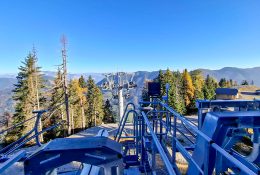
The Vitranc 2 chairlift takes you to the summit of Vitranc, where you’ll be treated to a magnificent view of the Julian Alps, the Karawanks, and neighboring Austria and Italy.

The Ledena Planica Ice Rink, covering 900 m², is considered one of the largest ice rinks in this region.

Where the silence of snow-covered mountains meets the magic of festive lights.

The forest educational trail reveals characteristic tree species, shrubs, and protected mountain vegetation.

A cycling route that winds through the longest valley under Triglav.

One of the most panoramic tours around Kranjska Gora, with a beautiful view of the Julian Alps accompanying us at all times on this route.

A scenic cycling climb through forests to a scenic mountain with breath-taking views of the Karavanke Mountains, the Julian Mountains and Mežakla.

The wide valley between Dovje and Jesenice lies between the sunny Karavanke Mountains and the shady Mežakla Mountains, connected by a scenic forest road.

A steep cycling climb with stunning views of the Martuljka Group and the murmuring waterfalls of the Jerman Stream.

A cycling trip from Kranjska Gora through picturesque Rateče to Tromeja, where views of three lands intertwine.
In Kranjska Gora and the surrounding areas, lively experiences of the Julian Alps await you. There are plenty of experiences that you want to try for yourself, from actively spending your holidays to peacefully discovering your natural and cultural heritage. You can discover the secrets of well-being in the rich wellness offer, attend business and social meetings or explore the mystical past of the Upper Sava Valley with your family. This is where the adventure begins!

The story of the mountain village of Dovje–Mojstrana - where tradition, nature, and mountaineering come together beneath the peaks of the Julian Alps.

On the occasion of the 120th anniversary of Slovenian Film, the films Kekec (1951) and Srečno, Kekec (1963) were digitally restored. Find out how the restoration process that brought two key films of Slovenian film heritage to life.

Ideas for family trips around Kranjska Gora.

Pasta Grannies visits Slovenia!

The days are getting shorter and the nights are getting longer. We have already stepped into autumn, the tops of the highest mountains have already been whitened by first snow and morning temperatures are already falling below zero in the valley. We have gathered for you some activities that you can do iduring the visit of tourist destination Kranjska Gora.

The Fourth World Bee Day is taking place this year in the light of a special appeal not to mow public areas and lawns around houses due to the frost, which has severely affected fruit trees. The destination Kranjska Gora also joined this appeal.

5 tips on what to do in bad weather in Kranjska Gora.

At a respectful distance and at the foot of the Alps, the path will lead you along the edge of the Julian Alps and the Triglav National Park.