

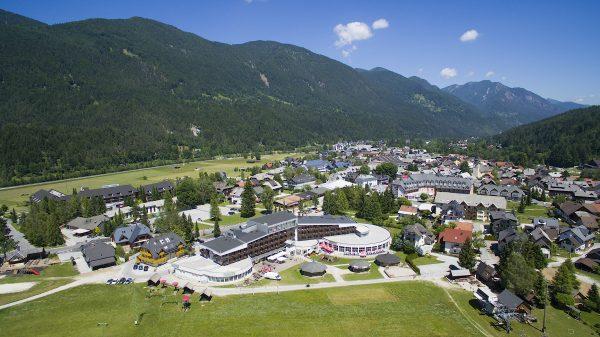
On the edge of the Julian Alps, where the valley opens up toward the mighty Triglav Northern Face, lie Dovje and Mojstrana. Today, they are known as the Mountain Village of Dovje–Mojstrana—a place where the mountains are part of everyday life, and nature is a source of respect, responsibility, and inspiration. However, the Mountain Village is not limited to these two villages; it also includes Belca and Zgornja Radovna.
This is a place where stories of farmers, ironworkers, and the first mountaineers still live on among the mountains that have shaped the lives of the people in the valley for centuries.
Among ancient trails and early settlements
The oldest settlement in this area is Dovje, which was first mentioned in written sources as early as 1033. At that time, travelers, merchants, and pilgrims passed through the Upper Sava Valley on their way between Carinthia and Friuli.
Settlement began gradually. After the estate in Dovje was donated to the Diocese of Freising, new residents began arriving in the area. The first large farms were established, shaping the character of the town and life in the valley.

Mojstrana and its ironworks heritage, the heritage and construction of the Ljubljana–Trbiž railway
Mojstrana developed somewhat differently. Its history was shaped by ironworking, which brought economic development to the valley.
With the discovery of iron ore in the Gorenjska region, ironworks sprang up along the waterways, where iron was extracted from the ore. The work required water power and large quantities of wood for charcoal production, so the nearby forests and the Vrata Valley served as an important source of raw materials. When the ironworks gradually declined due to the economic crisis, the idea of building a cement plant gave new impetus to economic development; it began operations in the Mojstrana area in 1893, but the economic crisis contributed to its closure in the 1930s. Mojstrana, along with all the villages beneath Triglav, prospered most with the construction of the railway line connecting Ljubljana with Trbiž. With the railway, the previously remote mountains became more accessible, and the summit of Triglav became much easier to conquer.
A place where the mountains have shaped life
Over time, Dovje and Mojstrana developed at the foot of the mountains, which have repeatedly shaped the lives of the people in the valley. The mountain trails once used by shepherds later became the paths of the first mountaineers, guided by locals—lumberjacks, hunters, and shepherds—who knew the mountain world intimately through their work.
The proximity of Triglav and the Vrata Valley gradually put the area on the map of Slovenian mountaineering. Generations of locals have developed a special relationship with the mountains—one based on respect for nature and the challenge of overcoming oneself. It is therefore no surprise that the first Slovenian climbers to conquer eight-thousanders come from the villages beneath Triglav.

Mountaineering village – Life with the Mountains and for the Mountains
“Beneath the peaks of the Julian Alps, tradition and life in the mountains are preserved not only in memories, but in the community’s everyday decisions.”
One such unanimous decision was for the villages beneath Triglav to become part of the elite family of Mountain Villages. Mountain villages are small, peaceful places characterized by a rich mountaineering and cultural tradition. All mountain villages share a commitment to preserving a high-quality living environment and landscape, as well as striving to fulfill the goals and implement the Alpine Convention.
Today, Dovje and Mojstrana bear the title of Mountain Villages (Bergsteigerdörfer). This is an international network of communities in the Alps that are building their future on sustainable mountain tourism, nature conservation, and respect for local traditions.
The core values of the mountaineering villages are:
- sustainable mountain tourism
- a responsible attitude toward nature
- safe and nature-friendly mountaineering
- respect for local traditions
- self-restraint regarding interventions in nature and tourism infrastructure
An important milestone for the community
On August 26, 2023, the Local Community of Dovje–Mojstrana officially joined the family of Mountaineering Villages as part of the 31st Aljaž Days.
The ceremony took place in the Vrata Valley, beneath the mighty north face of Triglav. With this, the area became the third mountaineering village in Slovenia, the first in the Julian Alps and the Triglav National Park.


Photo: Miloš Kozan
Discover paradise between Mount Triglav and the Karavanke Mountains
Today, Dovje and Mojstrana remain a place where nature, tradition, and modern mountaineering come together.
If you want to experience authentic Alpine scenery, explore hiking trails, or simply get a feel for life beneath Triglav, the mountaineering village of Dovje–Mojstrana always welcomes you with open arms.
Welcome to a place where the mountains are not just a view—but a way of life.




Comments (0)